Living on the Water in Bonita Springs: An Owner's Guide
Two very different kinds of waterfront share this city, the working boating canals off the Imperial River, and the marina-style communities where the boat lives somewhere managed.
- Two kinds of waterfront
- Working boating canals, and marina-style communities
- The daily reality
- Salt works around the clock. A rinse routine beats any product
- The river's two moods
- Tidal near the mouth, freshwater well upstream
- Wildlife
- Check FWC. Seasons and protected status are theirs to set, not ours
- What carries
- Sound, light and wake cross open water; they do not cross lawns
Key takeaways
- Bonita has two distinct waterfront experiences: working canal neighborhoods off the Imperial River, and marina-style or dry-storage communities where the boat lives somewhere managed.
- In a boating canal neighborhood, the things neighbors actually discuss are width, turning room, clearance and what the water does at low tide.
- Salt is a condition, not an event. The cheapest thing you own is a hose, and using it beats every product on the shelf.
- Manatees included: seasons, size limits and protected status are FWC's to publish. Check FWC, not the dock next door.
- Water is not a lawn. Sound travels over it, light travels over it, and so does your wake.
Nobody hands you the water side at closing. The realtor’s job ended at the house and the inspector’s job ended at the house, so the part of the property you actually bought the place for arrives with no instructions, only habits and etiquette the rest of the street learned years ago.
So: the orientation, from the people who work on the water end of these lots.
What kind of waterfront did you actually buy?
Worth answering first, because Bonita has two quite different versions of it.
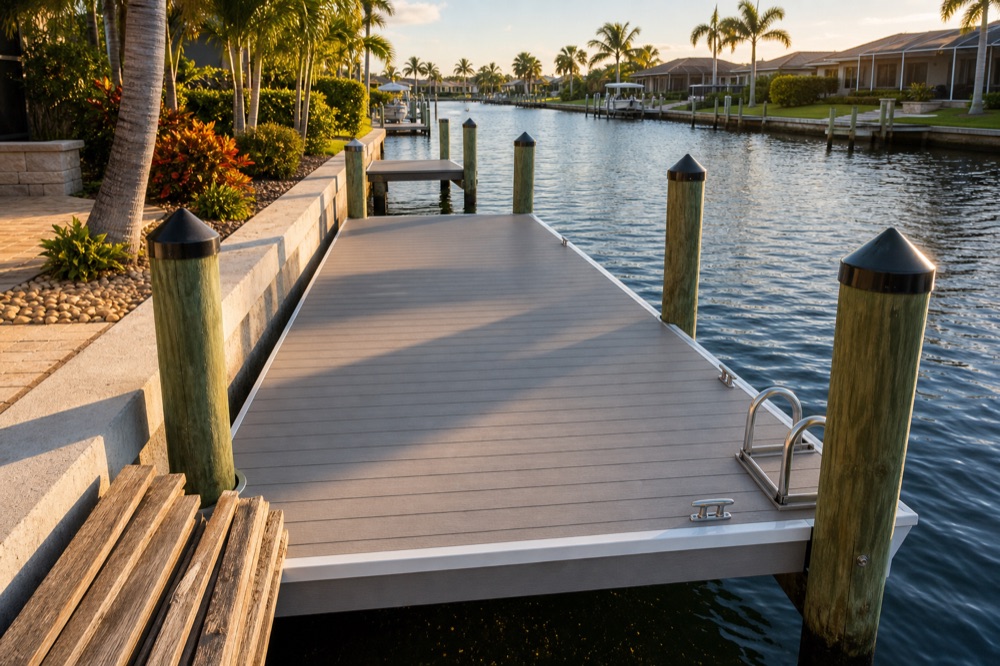
The working boating neighborhoods. Established canal and river-front areas: Bonita Farms, Pirates Cove and Imperial Shores are the names people use, where the boat lives behind the house on a private dock. The conversations here are practical ones: how wide the canal is, whether there is turning room for the boat somebody just bought, what clearance stands between the house and the bay, and what the water does at the bottom of the tide. Nobody in these neighborhoods is romantic about it. They are places built to keep boats.
The marina-style communities. Bonita Bay and the Bonita Boat Club are the familiar names for the other model: a managed marina or dry-storage arrangement where the boat lives in a facility rather than at the end of your lawn. Less maintenance in your hands, less spontaneity, more service.
Neither is better. They are different ownership experiences, and the difference shows most on a Tuesday evening when you have two hours free.
What the water asks of you every week
One habit, and it is free.
Salt does not arrive and leave. It sits on every metal thing out there and works at it continuously, so the answer is a routine rather than a purchase: hose the lift down after the boat has been out, rinse the hardware when you think of it, and never let metal build a crust.
Boat lift maintenance in saltwater sets out the rest of it, and zinc anodes are the part almost nobody replaces: designed to be consumed, and once gone the corrosion moves on to what they protected. Barnacles belong to the same subject: ordinary, mostly cosmetic, and a problem when they hide the piling underneath.
The thing that surprises people: the river has two moods
Not the tide, exactly. The fact that you are on a river as well as on tidal water.
The Imperial River runs from inland headwaters down to Fish Trap Bay, so its lower reaches are tidal and its upper reaches are fresh. Wherever along it you sit, the safe assumption is that hardware on this water lives in a marine environment and should be maintained like it.
The second mood shows up after heavy rain well inland. A river carries what falls on its watershed, and levels here can move for reasons that have nothing to do with the tide chart. In storm season that becomes something you actively watch, and our hurricane prep page covers it, while the water guide covers the system properly.
Day to day, what matters is the swing at your own dock. It decides how long a ladder has to be, how you set lines, and where a lift sits to be usable rather than merely installed.
Sharing the river
The water in front of the house is somebody else’s habitat, and on a system running from well inland down to the bay there is a lot of somebody else: wading birds at first light, fish under a dock light after dark, manatees passing through.
★ Get the rules from the source, not from the dock party. The Florida Fish and Wildlife Conservation Commission writes them, revises them and enforces them. Check FWC before you assume anything about a species, and take nothing secondhand. Secondhand is how people end up fined.
Birds are the complaint everybody shares, and keeping them off is mostly about removing the comfortable perches and then staying consistent about it. Mangroves grow along stretches of this shoreline. Florida protects them, trimming is regulated, and the penalties are real. Trimming them is not a service we offer, and Florida mangrove trimming rules is the honest version.
What travels across water
Water carries what a lawn absorbs. New owners get caught by this in the first month.
Sound. A canal is a hard flat surface. A conversation held on your dock at ten in the evening lands in a bedroom on the far bank.
Light. A dock you cannot see at night is a dock you stop using after dark, so lighting earns its place. Aim matters more than output: a floodlight pointed across the water is somebody else’s problem all night. Dock lighting done properly is placement and warmth, and fish lights under the surface are the quiet pleasure half of the same subject.
Wake. This is the one that costs money, and not necessarily yours. A wake you throw arrives at a neighbor’s lines, a neighbor’s hull and a neighbor’s shoreline. In a residential canal, idle speed stops being manners and becomes maintenance.
Whose water is it?
Not yours, as a rule, and the body responsible for looking after it is not a single answer either: city, county, district or private, depending on the stretch. That stops being academic the first time the trouble is debris, shoaling, or anything else that sits in the water instead of on the lawn. Who maintains canals in Southwest Florida tells you how to establish which one applies to a given address.
While we are drawing lines: we do not dredge, and we do not trim mangroves. Those are other people’s trades, with their own permitting, and sending you to the right people beats taking work we are wrong for.
The small things that decide whether you use it
Nobody regrets the dock. What people regret is the hardware they left off it.
- A ladder that still reaches at the bottom of the tide, mounted where a person actually climbs out rather than where it was convenient to bolt.
- More cleats than you think you need, put where the lines actually want to go, not spaced out evenly.
- A freshwater bibb the boat can reach, because every rinse habit above depends on having one.
- Light on the deck, aimed down, enough to walk the boards at nine at night.
- Somewhere to put lines, fenders and gear that is not the deck itself.
Essential dock accessories and upgrades has the whole list, and paddle craft deserve a plan of their own on a river: racks or a small-craft lift is far easier to build in than to add later.
If the house sits empty part of the year
If you are not here year-round, the water side still needs somebody who can get to it. Salt does not pause for the summer, and during storm season someone has to be able to physically reach the dock on short notice. Dock and lift care while you are away covers the routine.
If you remember five things
Rinse the metal. Learn what your slip does at the bottom of the tide, then set the ladder, the lines and the lift for that rather than for a pleasant afternoon. Take wildlife rules from FWC. Assume your light and your wake land on somebody else’s property, because they do. And put the last few hundred dollars into small hardware instead of square footage.
Welcome to the water. If you need anything built, repaired or looked at: (239) 397-3400.
The rest of our Bonita Springs library: permits, water, storms, and what we actually see on these docks.