
Seawalls & Shorelines in Bonita Springs: What Holds Up Here
Bonita's waterfront is not one kind of edge. It runs from engineered wall in the canal neighborhoods to natural, mangrove-lined bank along the river, and the right answer changes as you move along it.
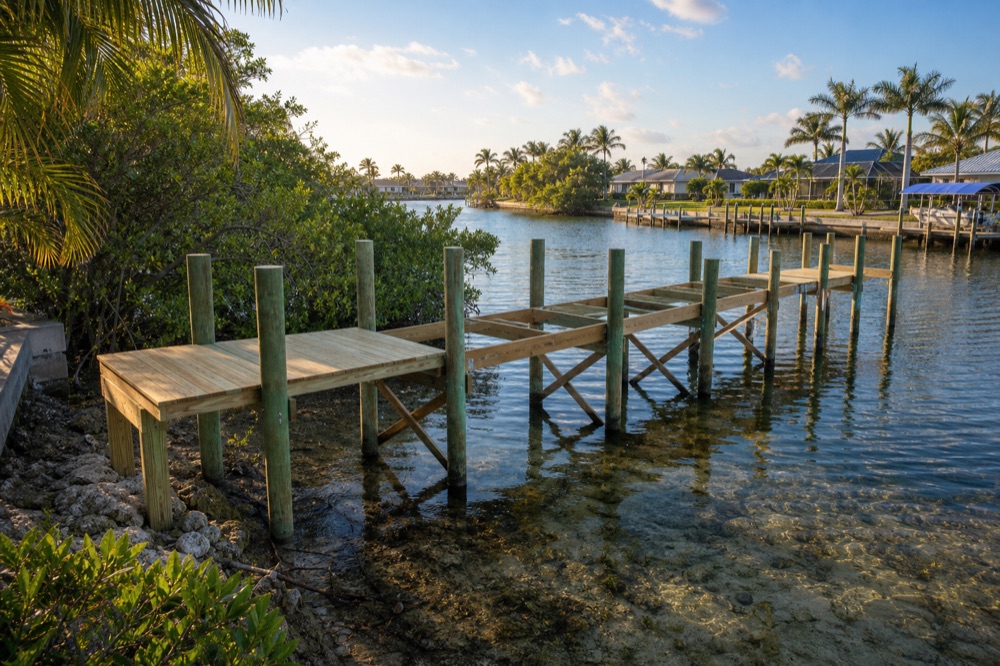
- The local difference
- A genuine range of shoreline types, not one uniform seawall grid
- Engineered edge
- Concrete or vinyl wall, most common in the canal neighborhoods
- Softer edge
- Rock, and natural mangrove-lined bank along stretches of the river
- The wider water
- Estero Bay, which carries a state aquatic preserve designation
- What we don't do
- We do not trim mangroves, and we do not dredge
Key takeaways
- Bonita Springs does not have one kind of shoreline. It runs from engineered concrete or vinyl wall in the canal neighborhoods to rock, and to natural mangrove-lined bank along stretches of the Imperial River and out toward Estero Bay.
- That range is the local difference. In a uniform canal grid the only question is what condition the wall is in; here the first question is what kind of edge you actually own.
- Concrete and vinyl fail by different routes, but both routes end in the same three places: behind the wall, at the cap, and under the foot.
- Your yard reports a wall's condition before the wall does. Soft ground, a settling paver and a widening cap crack are the cheap rungs of the ladder.
- Rock at the base is the most direct answer to undermining at the foot, and it needs horizontal room to work because it lies back on a slope.
Most waterfront markets on this coast hand an owner one shoreline question: how is the wall holding up. Bonita Springs asks something else first, and owners who skip past it end up pricing a project they do not have.
This is a river-and-bay town, and the edge changes as you move along the water. The canal neighborhoods are largely engineered wall. Along stretches of the Imperial River, and out toward Estero Bay, the bank is often softer, vegetated and mangrove-lined. Plenty of lots hold both, a wall at one end of the frontage and a living bank at the other.
What kind of shoreline do you actually own?
Start here. The answer changes everything downstream of it.
| The edge you have | What it usually needs |
|---|---|
| Engineered wall: concrete or vinyl with a cap | Condition monitoring, drainage behind it, cap attention, and eventually a repair-or-replace call |
| Rock: rip-rap along the toe or as the shoreline itself | Slope and horizontal room, periodic checking that stone has not migrated or settled |
| Natural bank: vegetated, often mangrove-lined | A far more regulated conversation, and a structure designed to reach the water rather than reshape the bank |
Owners price the wrong work all the time, having assumed one row and owned another. Settle it standing at the water, not from the driveway.
What is actually loading your edge?
Three things, and the third one is the local one.
The tide at the face. The same band of wall, worked twice a day, for decades. Nothing dramatic ever happens and it ages anyway.
The ground behind it. Saturated soil weighs more and pushes harder than drained soil, which makes drainage about the only structural variable an owner can do much about. When weep holes clog, a wall loses the one relief valve it has.
The river. A river carries whatever falls across its watershed, so the water in front of a Bonita edge can rise and run for reasons that never appear on a tide chart. A dredged canal fills and empties. A river does that and also moves past you, and after heavy rain well inland it moves differently. The canal and water guide covers the system, and hurricane prep covers the storm-season version of it.
None of that produces a number to look up. It produces a reason to check your own cap and foot more often than a sheltered dredged canal would ask.
No edge here keeps a yard dry. A seawall is not a flood barrier. No repair makes it one. Surge versus seawall height is where that argument lives.
So is it concrete or vinyl?
Owners open with this one. It settles less than the row you picked above.
Concrete holds much of the older frontage here, and nothing about the way it gives out starts where you can see it. Water reaches the steel inside the panel, the steel does what steel does in salt, and the visible face is the last part of the wall to report any of it.
Vinyl goes into most new walls and most replacements. Salt does not touch the panel. Salt does reach everything the panel is not: the tiebacks and anchors buried behind it, which are steel sitting in wet ground, the cap poured along the top, and the soil behind it, which holds water whatever the panel is made of. Vinyl versus concrete works the comparison through honestly.
Either material ends in the same argument with the same three things: what is trapped behind the wall, what is happening at the cap, and what is left under the foot. Material picks the route, not the destination.
Where does a wall tell you it is in trouble?
In the yard, weeks or years before the wall says anything itself.
Walk the line between the house and the water now and then, and read it in this order:
- The lawn goes soft, or a paver keeps sinking back after you reset it. Ground is escaping past the wall, and ground that leaves does not come back by itself.
- A cap crack that was hairline last spring is not hairline now. Water has found a path into the middle of the structure.
- A hollow opens under the foot, visible only when the water is low. The bed the wall stands on is being carried off. This is the quiet one, and the expensive one.
- The top line wanders. Sight along the cap from one end of the frontage: a stretch that has stopped agreeing with its neighbors has moved, and the buried tiebacks are what moved it.
Those are not four separate problems. They are one problem at four prices, and the first two are the cheap ones. The longer symptom list runs further than this one, and repair versus replacement covers how that call actually gets made.
Where does rock fit?
Under a wall, in front of it, and sometimes instead of it.
Water arriving at a flat vertical panel has nowhere to go but down, and down is where the bed is. Stone breaks that up: the energy scatters into the voids between pieces rather than landing in one place. That is aimed squarely at undermining, which closes out more walls on this coast than any material choice ever will. Rip-rap at a failing seawall toe covers the pairing, which is what rock usually is here rather than a replacement.
Rock as the whole shoreline depends on how much room the lot has to give, because stone has to lie back on a slope, and a slope eats horizontal yard a vertical panel would have kept. Given that room, a rock edge is a proper shoreline and a considerably livelier one than a flat panel. The rip-rap page has the detail.
What about the natural stretches?
More regulated, and worth being straight about.
Where the bank is vegetated and mangrove-lined rather than walled, you are in a different conversation entirely, and out toward the wider water Estero Bay carries a state aquatic preserve designation. What that means for any particular parcel is not something to characterize from a web page. It belongs to the reviewing agencies, and to your own confirmation.
Here is our own limit, stated plainly: we do not trim mangroves, and we do not dredge. For anything wildlife or species related along that shoreline, check FWC rather than a contractor. What we can do is design a structure that reaches usable water without asking a natural bank to become something it is not.
When is the right time to deal with it?
Earlier than the point where it becomes obvious, because obvious is the expensive end.
Once any of it turns into a project, it is permitted work: locally through the City of Bonita Springs, with state and federal approvals where they apply. Seawall permits in Bonita Springs covers that side of it.
If the ground along your wall line will not stay put, or a cap crack has grown since you last looked, get eyes on it before the scope grows. Seawall work is what we do, and an on-site estimate anywhere on Bonita Springs water is free. Call (239) 397-3400.
The rest of our Bonita Springs library: permits, water, storms, and what we actually see on these docks.