
Dock & Lift Repair in Bonita Springs: Failures We See
A short list repeats itself along the Imperial River and the canals feeding it. Where each failure begins, which one changes your week, and which one owners keep putting off.
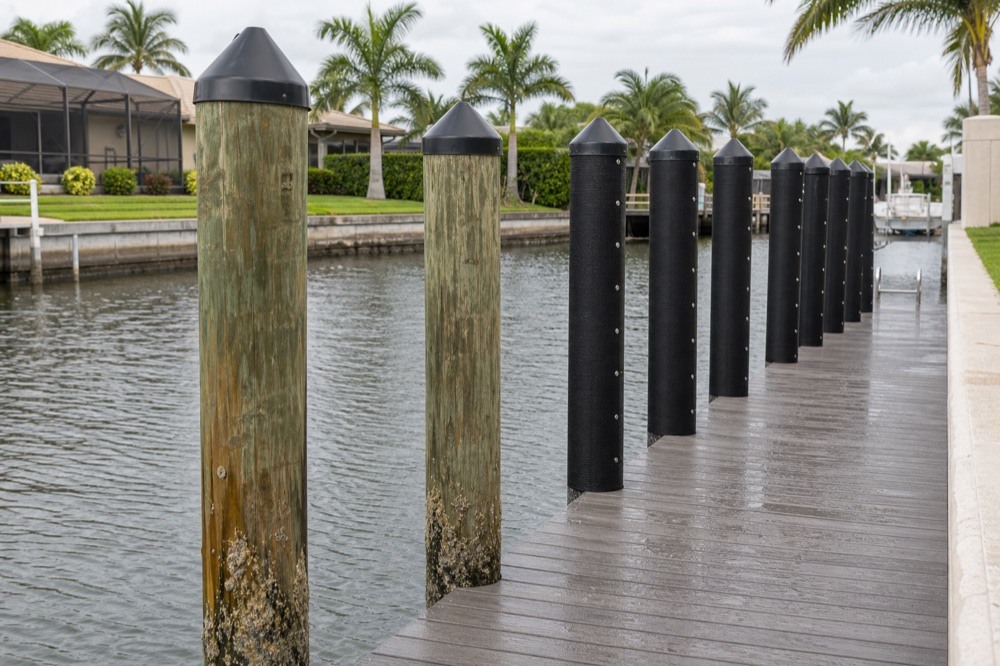
- Goes first
- The steel, not the timber. Bolts, brackets and hangers give up ahead of the wood.
- Act today
- A piling that gives under your hand
- Least inspected
- Lift cables, right up to the morning one lets go
- The Bonita tell
- A silt line above the usual waterline, left by the river rising on upstream rain
- Costliest to postpone
- Anything happening at the bank itself
Key takeaways
- The steel goes before the wood. Bolts lose their bite, brackets thin from the outside in, and a joint can be slack while the timber it holds is still sound.
- Push on every piling once a season. One that gives has a soil problem, and on a river bank the gap only widens from there.
- Cables carry the most and get looked at the least. When one parts it is sudden, it is loaded, and the boat is up.
- Read the line the water left. Here the river rises on inland rain as readily as on a surge off the coast, and that line marks what got wet.
- Position on the river sets the pattern. Open frontage near the bay wears mechanically. Sheltered upriver frontage corrodes quietly instead.
Most of what we get called out for here is not dramatic. It is a short list of failures that turns up again and again along the Imperial River and the canals off it, in roughly the same order, driven by salt, moving water and load.
The useful part: an owner can find most of it without a ladder or a boat.
What gives out first?
The hardware. Not the timber it is holding together.
A dock here is a timber assembly held together by its steel, and the steel is the half this water reaches first. Bolts lose their bite in the wood, brackets and hangers give up section from the outside in, and tight joints begin to move a fraction at a time. None of it shows from the deck. It is audible and underfoot, which is why owners describe the problem before they can point at it.
The tell is a stain. Rust running down from a fastener head is corrosion reporting itself early, and so are bolts standing proud, bolt holes worn oval, daylight where two members meet, and brackets thin at the edge.
Handled while it is still only hardware, this is the cheapest work on the page. Left alone, the bill moves onto the framing the steel was carrying.
What changes your plans the same day?
A piling that moves.
Push on it. If it gives, or a bay of decking shifts when somebody walks across it, the ground is no longer gripping that piling, on a river bank, as much a soil question as a timber one. It does not improve on its own: every tide, wake and load works the gap wider, and the ground never closes back around it.
This is the one finding worth acting on today rather than adding to a list. Whether it has lost its grip or lost its material decides what comes next; repair versus replace on a leaning piling covers the difference, piling inspection after a storm how to read one honestly, and marine borers why the part that decides it is the part nobody sees from above.
Which part gets looked at least?
The lift cables, and it is not close.
They carry the most and get inspected the least, and when they let go it happens all at once, under load, with a boat in the air, so the cable is rarely the only thing replaced afterwards. There is no honest interval to quote for them.
What there is instead is looking. Run the whole length past your eyes, including the wraps you cannot see from the deck: fraying, broken strands, rust weeping from between the strands and flattened spots all mean replace now rather than next season. Cable replacement warning signs goes through it.
Two more while you are at the lift. Zinc anodes get skipped more than anything else: they are meant to be consumed, and once gone the corrosion moves on to what they protected. And a lift that has stopped moving is usually less alarming than it feels: faults often turn out to be electrical, control or limit-switch problems, and lift troubleshooting covers what to check. Do not improvise on the electrical side.
What does high water leave behind?
This is the Bonita-specific item, and it is worth looking for deliberately.
Water here does not only arrive from the coast, the river and its canals also rise from rainfall runoff moving downstream from inland, which our Bonita Springs hurricane prep page explains. The practical consequence at the dock is that things that are normally dry occasionally are not.
A silt or stain line above the usual waterline on a piling, a seawall face, a lift motor housing or a dock box is telling you how high the water got. Read it, then check what was inside that line:
- Lift motors, control boxes and any electrical. Circuits stay off at the breaker until a licensed electrician has inspected them; post-storm electrical safety explains why that rule is absolute here.
- Connections, for the uplift that immersion applies in directions the structure was not designed for.
- Piling bases, for scour where moving water has taken material away.
- Whatever the water carried. High water arrives with debris in it, and some of it stays wedged in framing under the deck.
Post-storm dock triage is the full sequence.
Does position on the river change the pattern?
It changes the pace and the emphasis.
Frontage near the bay end, more open water in front of it, more wind fetch: sees more mechanical wear. Chop moves things. Fenders wear, hardware loosens faster, boats work against their bunks, and everything cycles more often.
Sheltered upriver frontage sees less movement and more slow chemistry: corrosion, growth, and borers working quietly. Less drama, same clock.
Our Bonita Springs water guide covers which category an address is likely in, and canal fetch and waves explains the mechanism. Where the bank is natural rather than walled, the questions change again, our seawall and shoreline guide covers that range.
Repair, or start over?
It depends which layer is failing, and there are not many layers.
The surface: boards, a ladder, cleats, trim hardware: is maintenance: it wears out, it gets replaced, nothing follows.
The connections are repair work, and the layer where being early saves money: loose hardware recruits the framing into the problem.
One or two pilings is usually a targeted job: reset, supplement or replace those and leave the rest alone.
Framing broadly, or most of the pilings, is a different conversation, and it costs more to avoid than to have: repairing pieces of a structure that is finishing its life is spending on somebody else’s timetable.
The trap is the cosmetic fix: fresh decking over tired framing. It looks excellent, changes nothing structural, and hides the layer that mattered for another decade. Repair or replace a dock in Florida walks the decision honestly.
The short list worth doing yourself
Four things, on a rhythm. Push on the pilings once a season. Run your eyes down the full length of the lift cables twice a year. Walk the ground behind the shoreline for soft spots and dips. And whenever the water has been up, read the line it left before assuming nothing happened, the one this city adds to the list.
If something out there has started moving, sounding different or bleeding rust, we will come and look, and tell you honestly whether it is a repair or something bigger. Free on-site estimate anywhere in Bonita Springs: (239) 397-3400.
The rest of our Bonita Springs library: permits, water, storms, and what we actually see on these docks.